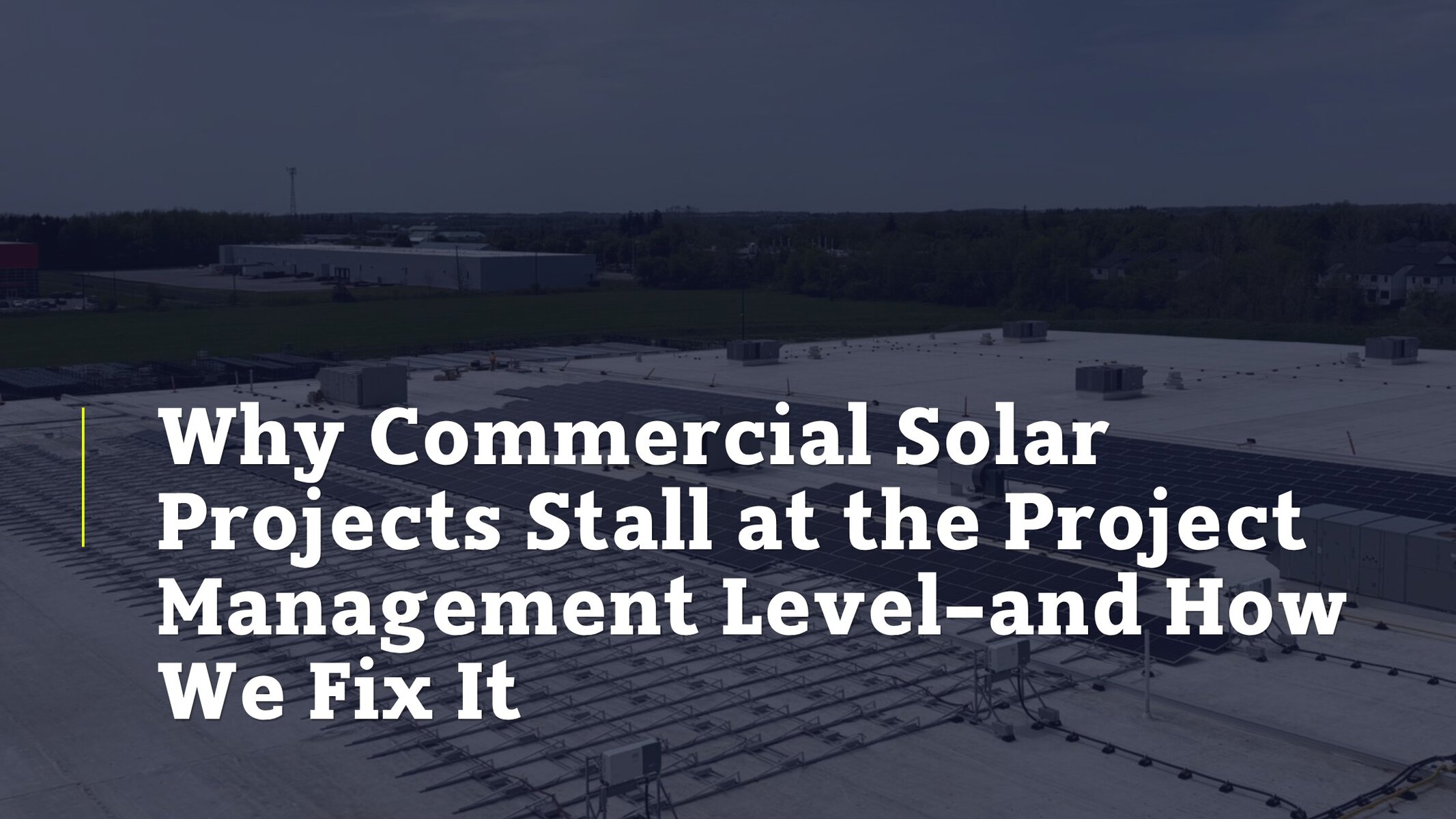
Why Commercial Solar Projects Stall at the Project Management Level—and How We Fix It
When a business decides to invest in solar energy, executives and facility managers naturally focus on the tangible elements: the efficiency of the photovoltaic panels, the projected utility savings, or how the asset hedges against unpredictable carbon pricing.
But behind the promise of lower hydro bills lies a complex web of logistics. A single commercial solar installation involves structural assessments, electrical engineering, localized utility capacity verifications, environmental approvals, and multi-layered safety certifications.
The hard truth of our industry is that commercial solar projects rarely fail because of the science; they fail because of the project management. At Otter Energy, we have spent 18 years refining the deployment of clean energy. Our Statement of Qualifications isn’t just a corporate portfolio—it is a testament to how we have systematically eliminated the red tape that stalls traditional solar builds. Here is a look behind the curtain at why solar project management is the ultimate constraint, and how we solve it.
The Subcontracting Trap: Where Projects Go to Die
The typical commercial solar developer operates on a “brokerage” model. They design the system, select the equipment, and then commission a web of independent third-party subcontractors—independent engineers, outside electricians, and hired mechanical crews—to build it.
This fragmentation introduces a massive project management risk:
The Red Tape Bottleneck: If a structural challenge arises on the roof during installation, the mechanical crew stops work. They must wait for the developer to contact the outsourced engineering firm, who must then schedule a site visit, modify the drawings, and send them back. Meanwhile, the clock ticks, labor costs mount, and your operational timeline gets derailed.
Finger-Pointing Accountability: When an outsourced project experiences a delay or performance issue, the blame is passed around. The installer blames the engineer; the engineer blames the equipment supplier; the developer blames the utility.
The Otter Solution: 100% In-House Execution
We built a different model. Otter Energy operates with a full-time, in-house team of over 80 professionals—including our own engineers, master electricians, journeymen, mechanical installers, site supervisors, and project managers.
Because every hand on your roof is an Otter employee, there is zero red tape. If a design needs a real-time adjustment on-site, our field crews communicate instantly with our engineering team. Communication is seamless, quality control is absolute, and project accountability rests squarely on one set of shoulders: ours.
18+ Years of “Predictable Surprises”
In construction, surprises happen. Weather changes, local building departments request unexpected paperwork, or a local utility distribution grid exhibits a sudden constraint. The difference between an on-time project and a multi-month delay comes down to whether your partner has spent nearly two decades building contingencies for those exact scenarios.
Since our inception in 2009, we have installed over 170 MW of solar capacity. Through thousands of hours in the field, we have mapped out a rigorous, five-phase risk mitigation methodology that handles surprises before they can impact your bottom line:
Phase 1: Design & Engineering: Long before a panel arrives, we secure written grid capacity confirmation from the utility and handle Connection Impact Assessments (CIAs) in-house, backed by our experience with over 100 successful CIAs.
Phase 2: Procurement: Supply chain delays can paralyze a build. Otter leverages advanced procurement and deep manufacturer relationships to secure modules, inverters, and racking well ahead of mobilization.
Phase 3: Pre-Construction & Logistics: We don’t just show up. We own our own fleet of heavy equipment—including boom trucks and telehandlers—ensuring we are never at the mercy of third-party rental availability or sudden delivery delays.
Phase 4 & 5: Construction & Commissioning: From conducting proactive ESA rough-in inspections to managing the local utility’s strict testing milestones, we map every single day out to guarantee a smooth path to your active “authorization to generate.”
Proven by Audits, Not Just Words
It’s easy for a company to promise an “on-time, on-budget” installation. It’s another thing entirely to back it up with rigorous, independent data.
Otter Energy is proud to be the only solar provider in Canada that is ISO 9001:2015 certified. ISO 9001 is the international gold standard for quality management systems. To maintain this certification, we don’t just check our own boxes—we submit to intense, annual third-party audits that evaluate our business processes, communication channels, and project delivery precision.
When global logistics leaders like Kuehne + Nagel, industrial giants like Timbren Industries, or clean energy funds like Potentia Renewables trust us with multi-million dollar portfolios, they do so because our track record is unassailable. Across dozens of complex, multi-megawatt rollouts, our client references share a common denominator: Project completed on-schedule and on-budget.
Moving Past the Constraint
If your company has been hesitant to transition to solar because you are worried about the logistical headache, the endless noise, or the administrative strain on your facility manager, you are looking at the right risk.
But when you choose an unfragmented, fully integrated partner with nearly two decades of localized expertise, project management ceases to be a constraint. It becomes your greatest competitive advantage.
Start Your Feasibility Study
Please fill out the form and we’ll get back to you as soon as possible.

